Last Summer I wrote about a pair of whitetail fawns growing up in the field beyond the local Elks Lodge. The Lodge sits on one side of a hollow at the base of Pine Mountain, my house is at the top of the mountain, and my road meanders down the side opposite from the Lodge. There is a large whitetail herd and it’s not uncommon to see the same deer at any spot along the mountain.

This is a shot of the friendly fawn from last summer.
Over the years I have photographed a doe that is easily recognized by a thin white strip on just above her black nose. She is friendly and curious about me and tolerates me approaching her to take photos. I respect her space and back off if she shows any sign of concern. Last year she had two fawns – one with a black nose and one with a white stripe that had a wide spot in the center. Like it’s momma, the one with the white stripe had no concern about my presence and was actually very curious.

This shot gives a clearer picture of the marking in the fawn’s nose.
That original doe was one of triplets and was the only one with the white mark. Her sister still stays close and is not at all friendly. She starts snorting almost as soon as I leave my jeep. That friendly doe has had two sets of twins and only one of those has a white stripe and only that one is really friendly like she is. The others have been very cautious and quick to run off. Last year I was lucky to get so close to the friendly fawn on several occasions.

The tail tucked and low like this indicates no sense of alarm. Whitetail use their tails like flags when alarmed – the rest of the herd can spot them in the woods when the have it raised so the white hairs show.
I watched a documentary about the domestication of wolves – the forefathers of dogs. Humans and wolves have always interacted – wolves feeding off of livestock or the trash of people. In a pack of wolves there is usually one or two who are bolder around humans. These wolves are the ones who make friends with humans and by doing so they can secure food and comfort for the pack – they are like ambassadors. Scientists have found that these dogs share a genetic marker and they call it the friendliness gene. This marker is also found in domesticated dogs today.
Not that this has anything to do with whitetail deer, but it got me thinking about why some deer are curious and some are flighty. The deer have no need to befriend me for food. I do find it an interesting coincidence that all of the deer in our small herd who are comfortable and even curious about me and my camera seem to have a similar white stripe on their nose – is it nature or nurture? Does the original doe’s boldness embolden some of her fawns?

Notice how the doe has no concern or alarm, she even turns her back on me when her fawn is nearby.
Of course winter comes and the whitetail move deep into the hollow. I put my thoughts about this friendly trait away for winter. The deer stay away from the field once hunting season opens and have yet to make an appearance there this year. I have seen a couple on the roadside running into the woods, so they are on the move.
A couple of days ago I saw a deer ahead of me on the road. It didn’t bolt – it just looked my way and walked leisurely into the woods. I pulled up along side and it looked over its shoulder at me…
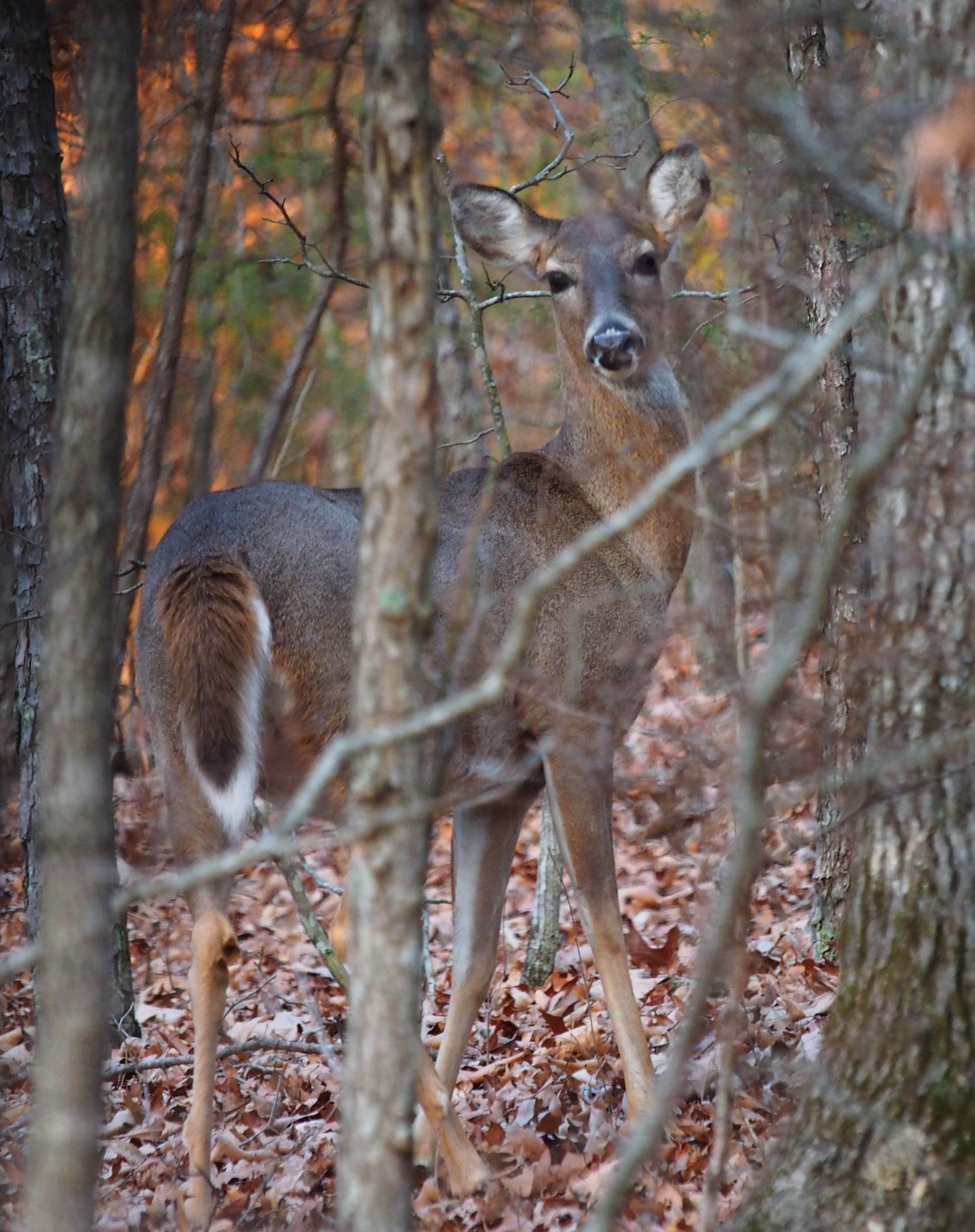
Unconcerned with me or my noisy jeep, this yearling looked at me.
I stayed in the jeep – opened the passenger window and snapped a few shots. I was taken aback by how long the young whitetail looked at me and at its calm demeanor. And then I saw it…
 This was not any yearling, this was my friendly fawn. No wonder it showed no concern for me, it knows me. It survived the winter in the hollow and is now roaming over the hills.
It’s nice to catch up with old friends.
 the eff stop
Thank you for sharing your beautiful photos 🙂 I love doe-eyed people, friendly people, and aspire to be one.
Thanks, I think we have that friendliness gene too, at least I hope we do 🙂
You have that wonderful ability to give so much good energy. I believe it is you that has the friendly gene! Every single time I come to your blog, I leave feeling better about myself and the world. That last close-up pic of your pretty striper stirred up some unexpected emotion. Brilliant. Just brilliant!
Thanks so much Cissyblue. I like to think we all have that friendliness gene. I’m glad you enjoy the blog and my random thoughts 🙂
Pingback: Does the Friendliness Gene Exist? | Chaparchapar
Thanks for the reblog!!
Beautiful, thought provoking piece. I love the link with friendliness and the white marking on the nose, sweet. Lovely too to see a photo of the young fawn all grown up.
Thank you, I always watch for my favorites in the spring and it was great to see my friendly fawn so early in the year. I really wasn’t certain it was the same fawn until I got home to compare photos.
Mindblowing Pics!!!
Thank you!
🙂
These photos blew my mind. So beautiful and wonderfully captured. I like to think we all have a little friendliness gene in us. Thanks for sharing. 🙂
Thanks – I like to think we all do too! Thanks for the follow too!
What wonderful digital pictures of your friends! How did you get so close to take them and they not run away?
This deer let me get very close – the shot in the woods is from less than 10 feet. I just move slowly and back off if they start to run, but this deer and it’s mother rarely bolt or even move away.
Awesome blog and pictures. Thanks for sharing. http://www.segmation.wordpress.com
I’m following you now loved this post thank you for sharing with us. Melody
Now everytime I see a deer I will be looking for a white stripe on their nose!! 🙂 Great post and deer are soooo pretty.
Ha – totally unscientific – but I am anxious to see the new fawns this year to see if I can find some “stripers” – thanks so much!
Congratulations on being Fresh Pressed, this is a great post. Keep up the good work!
Thanks Allan – I wrote this on a whim over my lunch hour – you never know what will catch the editors’ eye 🙂
Quality will do it every time, as this post will attest.
Thanks for sharing these beautiful photos and your observations. I’ll bet that the momma’s behavior influences the little ones. Our parents teach us how to “be” in the world. I live on a meadow bordered by woods in New Hampshire, and I worry about the friendly deer who mosey up to the house to munch on the apple tree’s gifts. Don’t want them to get too friendly with my gun-toting neighbors! Congrats on being FP!
I wonder if the mother’s presence is a big factor – she is so laid back. Her mother was not. It’s interesting to see the families stay intact over the years too. We had a bad drought year last summer and the poor things were drinking from my dog’s water dishes outside – I started putting drinking water in the meadow near the treeline to keep them from the stress of competing with the dogs for water. They are creatures of opportunity so your apples are pretty appealing 🙂 Thanks for stopping by and commenting.
It’s always the mother, too, isn’t it? The males are always more stand-offish in my experience. First to huff and stamp their feet. We have a stream on our property, so we’ve been fortunate with water. Keep posting photos!
This yearlings father let me get a couple of shots last year while he was in velvet, but you’re right, the mother is the key. I shoot everyday, so I’ll be posting more photos very soon 😄
Whether friendly or not, deer are such sweet animals. Thank you for sharing your pics of them! 🙂
They really are sweet creatures. Thanks for stopping by!
i am touched by your lovely story. thanks.
Thanks so much for giving it a read!
I’m fairly certain that by “friendliness gene,” they don’t truly mean to anthropomorphize the trait. But, interesting post all the same.
I’m sure you are right – sometimes we see what we want to see in nature. Perhaps it’s that a couple of deer have less fear or a lower alert level. I’m just a photographer with a few subjects more willing than others 🙂
And wonderful photos they most certainly are.
Thank you!
Great post and amazing pictures!
Thank you for giving it a read! I appreciate it.
Great photos! though provoking too in comparison to human nature 🙂 nice
Thanks so much!
^_^
Nice photos of the deer. Nature vs. nurture is an interesting debate. I’m sure both play a role. My family has a cat that was the kitten of a cat that lived out in the country and didn’t belong to anyone. She’s extremely shy, but once she gets to know people, she can be very affectionate.
Thanks! Your cat reminds me of my pets. I have a dog that was given to me by a breeder. He’s a beautiful show dog that hates to be touched by strangers. The breeder didn’t want to continue his line because she worried that he would pass on the shyness trait – but then again you can see a wide variety of temperaments in human siblings. Both nature and nurture – even then it’s a anyone’s guess.
Lovely photos!
Thank you!
Fascinating…and such beautiful photos too.
Thanks so much!
What a beautiful story. It certainly does make you wonder. A good read that made me smile! Thank you so much for sharing!
Thanks for giving it a read. I’m fascinated with how animals choose to interact with us – I think sometimes they are as fascinated with us as we are with them.
I agree. Most don’t give them the credit they deserve.
Nice Pics and a wonderful read 🙂
Thanks so much for stopping by.
congrats on being freshly pressed Lorri! 🙂
Thanks Jackie! I wrote this on my lunch hour on a whim and got the notice that it would be FP’d about an hour later – crazy.
Just beautiful post – stunning photos!
Thanks so much!
Pingback: Does the Friendliness Gene Exist? | incikilic
Pingback: The Amazing Monkey Orchid » RickMick | RickMick
beautiful pictures….thanks for sharing!
you must have a wonderful view from your house…
Thank you! Actually my home is wooded in and I kind of like that. I have a 3 acre lawn completely surrounded by thick woods – I’m in a meadow in the woods. I can hike to a view, but it’s very private too.
sounds beautiful
Fascinating experience! Clearly the spectrum of intelligent life on Earth is much broader than humans have traditionally thought, and your experience with these deer is an indication of that. That’s also the subject of “Great Minds of this Dot” which describes the first encounter with intelligent life on Earth that an imaginary observer from elsewhere in the Universe has upon discovering this planet. You might enjoy it. http://notesfromthepalebluedot.com/2012/07/20/second-note-gr…ds-of-this-dot/
Really nice read and that video is powerful. I think the variety of expression in non-domesticated animals is probably at least as varied as it is among those we have bred to suit our needs like dogs or cattle, why wouldn’t it be. I think we sometimes view wildlife as having no expression beyond what we see in guide books. I had an experience with a whitetail raised in captivity many years ago and it’s playful nature surprised and delighted me. It wasn’t the presence of humans that made that nature – it was there all along.
Thank you. I fully agree. There’s a lot more we need to understand about the intelligence of wildlife. Another incredible video of whales – though less poetic – is this one http://youtu.be/BaPxbDn_jDc
You may have already heard of whale hugging, but I never cease to be amazed by this behaviour. Best wishes.
That is so amazing – I had never heard of whale hugging.
Great pictures! I had a similar experience with one deer who seemed fearless not only of me, but my husky. Usually deer would bolt if we got within 50 feet, but this one deer seemed to have no fear when we were no more than 10 feet away. Of course, I always had my husky on a leash, but it still amazed me that he/she was as curious of us as we were of him/her. Perhaps, the friendliness gene.
I had one experience with the whole herd where the doe’s sister started that snorting and pawing that they do before the bolt. The friendly doe walked to within about 15 feet of me and placed herself between me and the herd. I backed away slowly, but even as the herd was on alert she had no fear.
It doesn’t surprise me that your husky didn’t spook the deer – my friend has tolerated a large red jeep 🙂 Isn’t it a cool experience?
The best.
Congrats, Lorri on another FP nod. You’re awesome and of course, your pictures are wonderful!
Thanks Michelle. Funny how it happens on a post you write on a whim over a lunch break.
That’s the way it always is – enjoy the ride!
Great photos. Brings back fond memories of a couple of trips over your way that I have had.
Thanks – did you visit the southern states? I think whitetail are the state’s most common antelope.
What are classed as the southern states?
Cris-crossed over most states, although some just passed through on a bus. Southern states seen were Washington DC, Virginia, West Virginia, North Carolina, South Carolina, Georgia, Florida, Louisiana, Texas. Many many years ago. 1978. 🙂
I’m in Arkansas – just north of Louisiana – the Ozarks run through Arkansas, Missouri, and Oklahoma. Missouri is not considered southern – it all dates back to the American Civil War – southern states were the ones who seceded – so I’m 4 miles into the south 🙂
Ahh. You have refreshed my US geography. Thanks for that. One day, I will come back.
🙂
I think the friendliness gene definitely exists!
Me too 🙂
These were amazing pictures – they are looking right at you and connecting! I loved seeing the white heart on her left shoulder 🙂
That was one of the first things I noticed about the fawn – it was only later I noticed the nose stripe. Of course the heart is faded now. Thanks!
Oh I do love this… when an animal shows no fear as it realises that you are a friend… wonderful…
I think if you are with them they just see you as part of their world – thanks Bulldog.
I love the story you told with the photos, and am glad that you furry friend has survived another winter and remembers you. If dogs can have a friendliness gene, why not deer? And, while I know this may be a long-shot, but why not people too? ;-D!
Russ
LOL – how true Russ – occasionally you meet someone without it though 🙂
Great piece, LC. Genes drive a lot of behavior, at many levels. There is serious science being done on behavioral genetics, and my pal, Paul Zak, who discovered oxytocin, what he loosely labels “the moral molecule” (also the title of his new book), has found that levels of oxytocin correlate to feeling good or warmly about others. I suspect we share some elements with animals and other complex life. For example, inasmuch as slime mold can learn, we may discover that life at its most basic may contain biological bases for what we might regard as core behavior. Anyway, like you, I feel connected to all life forms (well, maybe not ALL), and consistently enjoy your good work. Thanks for sharing with us.
Thanks TPK – It seems that most domestic animals have a wide variety of demeanors – I have 4 dogs and they all have differing levels of friendliness. Why not in other animals. I recall “taming” a prairie dog when I was camping as a child – now I wonder if that one dog wasn’t predisposed to connecting as a means of gaining sustenance. It doesn’t make the connection any less real if it’s biological. I will have to check out that book – sounds very interesting.
That’s fascinating!
Thanks Jules 🙂
Wonderful!!!! How very cool.
Thanks Elyse. I thought it was pretty cool to come across my old pal in the woods.
I even remembered your other post about this…I love hearing the continued story. ❤
I have been visiting the meadow and none of the herd have made an appearance yet so it was a surprise to run into my old pal. 🙂
I bet – you are so connected – I love that about you!
🙂
Beautiful images, Lorri.
(you make an interesting point about the ‘friendliness’ gene. I sometimes feel that way about certain ducks on the lake near my home or even primates at the zoo. Researchers are doing a study at Melbourne Zoo at the moment. They have inserted a special screen on the viewing window of the tree-top monkeys. Humans can see the monkeys, but the monkeys can’t see the zoo visitors. They are studying to see if the monkeys exhibit different behaviours when they think they’re not observed. I hope they publish the results).
Vicki – that sounds like a fascinating study. I guess there’s no reason to believe that their temperaments are not at least as varied as those in dogs.
Så heldig du er som får oppleve så mye vakkert😃
Thank you – I am very lucky:)
Fascinating Lorri- to have that trait show up across several generations – will be cool to see what happens. We had an old doe on our AR property that would have her babies in our meadow every spring – kept them around our acreage all summer – she had an old injury to a leg – so it was easy for us to spot her. One winter we found her curled up just beyond our back gate – she had been dead for a while – feel that she had known it was time and she would be safe and not bothered by dogs or coyotes. Bob buried her at the top of our ridge. Funny how we have relationships with these beautiful wild creatures.
Just started snowing here not sticking yet! K
The original doe has an old injury on her side – that’s what I first used to know it was her. I do think they learn about safe places and that doe on your place did know it was a safe quiet space. Sweet of you and Bob to take care of her, I think she trusted you. I have them sleeping behind my shop even though the dogs are close by – they know the limits of the radio fence. They drink at the dogs’ water trough once the pups are inside too. It’s sticking here now – I’m heading home! L
Beautiful work.
Thank you!!
This is such an interesting post. How wonderful that some of the deer trust you! They sure are beautiful creatures. Great images. 🙂
Thanks Robin – who knows, maybe I just wondered into a friendly herd and it’s just a coincidence. I’m glad to see the yearling though.
Awwwww….You have a wonderful relationship with the fawn….awwwww..
I have so enjoyed this little deer – it’s good to see it growing and healthy. Apparently it is unafraid of red jeeps 🙂
Maybe that’s where the phrase “of the same stripe” comes from. hmmmm.
Hah – maybe so! No stripe, no like the photographer 🙂
Really interesting. I knew that about dogs, because I used to raise them. It being true of deer is an interesting theory and may be true. 🙂
Who knows – it may just be a genetic coincidence 🙂
Beautiful photos, you do great work!
Thank you!
That is fascinating. I continually try to figure out a comfortable distance so as not to disturb wildlife and the answer seems to vary a lot with individuals. I will now be looking for white stripes!
It is interesting how they vary by individual. I wasn’t exactly clear until I saw the photos a couple of years ago – I started noticing the sam deer over an over. It may just be an odd coincidence.
Wonderful post and beautiful pictures. I have seen the same documentary and read about how dogs evolved from wolves. Interesting case study you have here with your deer herd. Keep us posted. 🙂
Thanks – totally unscientific observation here – I will be watching this year’s fawns.
OMG! just amazing photos you got from the friendly white stripe herd. That is interesting, I think you could have something here. Maybe paint a white stripe on your nose and go chat with the unfriendly ones? I think nature rather than nurture because they are not around humans enough to be nurtured by them perhaps.
Thanks – it’s easy to get shots when they like you 🙂 I wondered about them being nurtured by a friendly doe – does her demeanor have an influence on them – who knows?